
Green Laser-Assisted Surface Structuring (GLASS): Bringing Biomimetic Anti-Reflective Glass to Industry
Glass is a critical material in modern technology, serving as the interface between users and devices in applications ranging from consumer electronics and optical systems to automotive displays, telecommunications, and solar energy. Despite continuous advances in glass manufacturing, unwanted light reflection remains a major challenge, reducing optical performance, energy efficiency, and user experience.
Today, anti-reflective (AR) functionality is typically achieved through multi-layer coating technologies that require complex manufacturing processes, multiple production steps, and the use of chemical substances. While effective, these approaches increase production costs, create environmental burdens, and may suffer from durability limitations under demanding operating conditions.
Nature offers an alternative solution. Many biological surfaces have evolved nanoscale structures that minimize reflection while maintaining transparency and robustness. Inspired by these natural systems, the GLASS project develops a novel laser-based manufacturing technology capable of directly creating biomimetic anti-reflective nanostructures on glass surfaces.
The GLASS approach replaces conventional coating processes with a single-step laser treatment that structures the glass itself. This eliminates the need for additional coating materials while enabling environmentally friendly production with reduced process complexity. The resulting surfaces exhibit remarkable anti-reflective properties, opening opportunities across multiple high-value sectors.
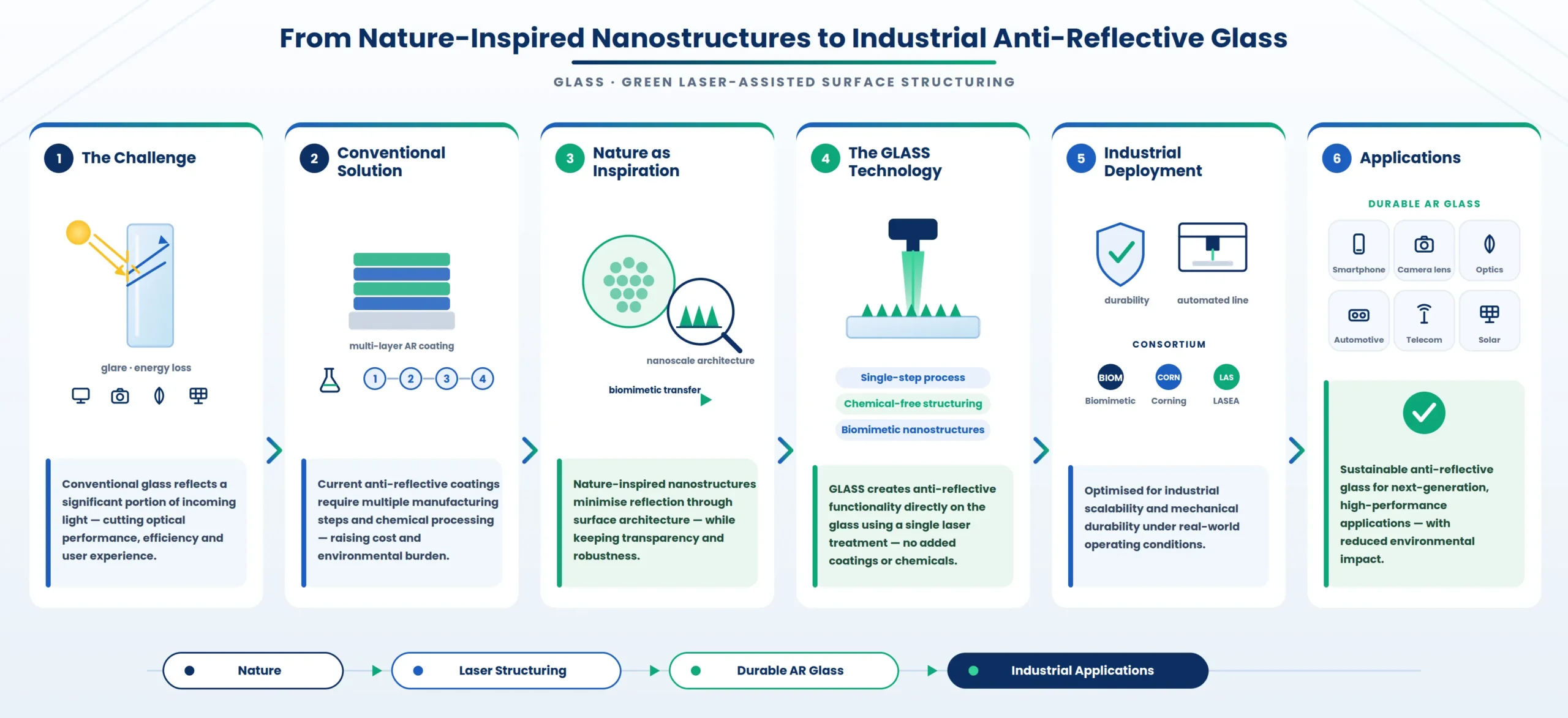
The technology originates from a long-term research and innovation pathway in biomimetic surface engineering and laser processing. The project now focuses on overcoming one of the most important barriers to industrial deployment: ensuring the mechanical durability and long-term reliability of laser-structured glass under real-world operating conditions.
To achieve this objective, GLASS brings together expertise from across the value chain:
- Biomimetic (Greece), developer of the core laser-based biomimetic structuring technology.
- Corning SAS (France), a global leader in advanced glass manufacturing and a key industrial validation partner.
- LASEA (Belgium), an established manufacturer of industrial laser systems supporting the development of automated processing solutions.
The consortium aims to transform a promising laboratory innovation into a scalable industrial process capable of producing durable anti-reflective glass for commercial applications, with particular emphasis on consumer electronics displays and specialized optical components.
By combining biomimicry, photonics, nanotechnology, and advanced manufacturing, GLASS seeks to establish a new generation of sustainable anti-reflective glass solutions that can enhance product performance while reducing environmental impact.